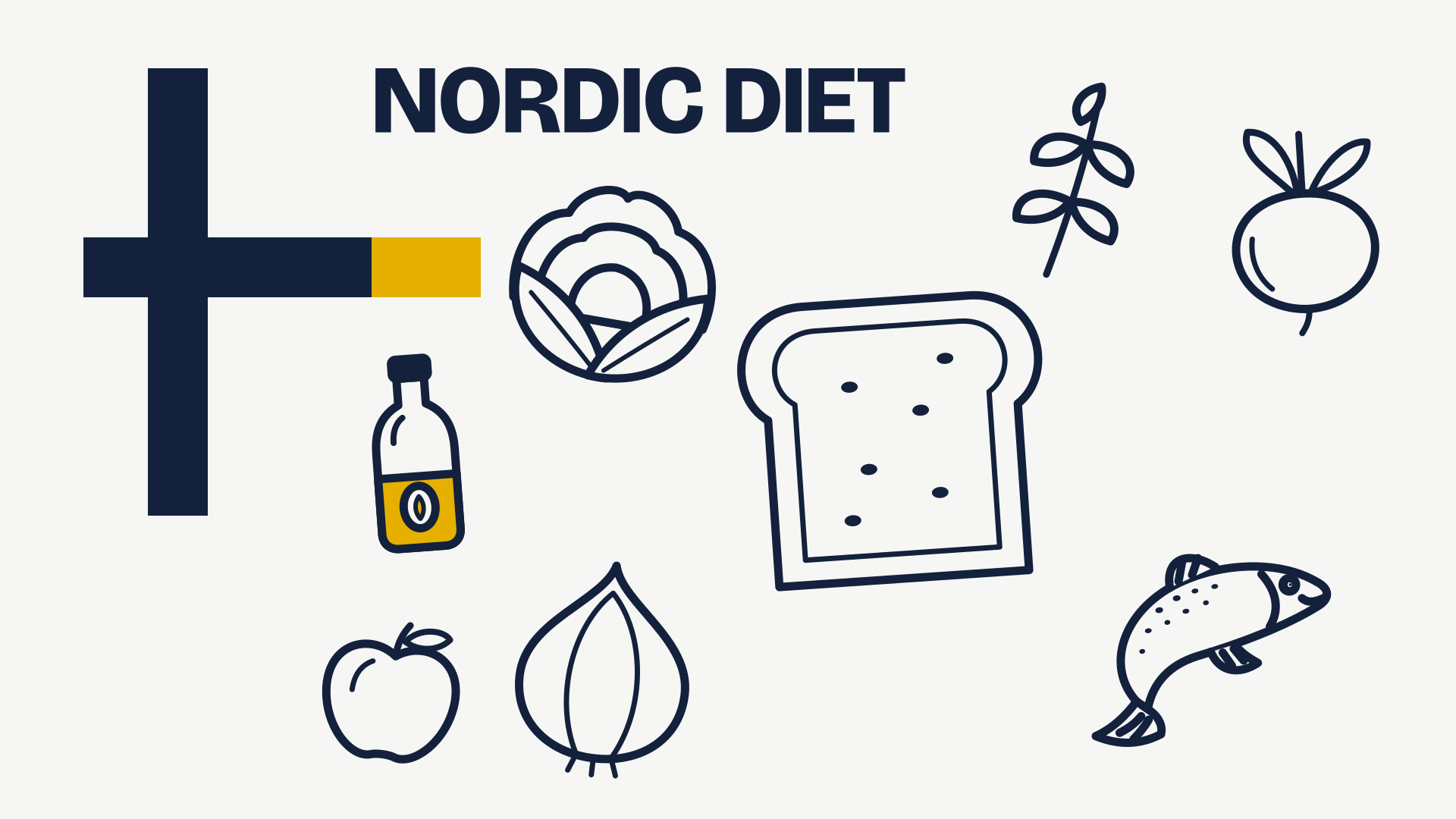
The Nordic diet: the Mediterranean diet in a woolly jumper.
Olive trees don't grow in Finland. So Nordic researchers asked: can we build a healthy diet out of what does grow up here? Rye, oats, cabbage, berries, herring and rapeseed oil. The answer is a cautious yes.
The short version
- What it is
- Whole-grain rye, oats and barley, oily fish, root vegetables, cabbage, berries, beans and rapeseed oil. Less meat, less sugar.
- Good for
- Modest drops in cholesterol and weight in trials. Easy to follow if you live in northern or central Europe.
- Bad at
- Big effects. And the traditional Nordic table is salty: pickled herring, cured fish, crispbread.
- Evidence
- Moderate. Small effects, consistent direction.
- Our take
- Perfect for our German, Austrian and Swiss users. Same principles as Mediterranean, local shopping list.
What the Nordic diet actually is
The Mediterranean diet has a problem in the north: it's built on olive oil, tomatoes and sunshine. If you live in Hamburg, Helsinki or Zurich, half the shopping list is imported. So from the 2000s on, researchers in Denmark, Sweden and Finland designed a "healthy Nordic diet" from local foods and tested it in trials.23
The building blocks: whole-grain rye, oats and barley; oily fish like herring, mackerel and salmon; root vegetables, cabbage and onions; berries such as blueberries, lingonberries and sea buckthorn; apples and pears; beans and peas; nuts and seeds; low-fat dairy; and rapeseed oil (canola) as the main fat. Meat shows up less often, preferably game or poultry. Sugar and processed food barely make the list.
It's not the traditional Viking feast, and it's not a smorgasbord of meatballs and cream sauce either. It's a modern, designed diet that happens to use northern ingredients.
How it works in your body
Basically the same way the Mediterranean diet does, with different ingredients.
Rye and oats bring a lot of fibre, including a kind called beta-glucan in oats and barley, which is linked to lower LDL cholesterol. Rapeseed oil is low in saturated fat and has some omega-3, and oily fish brings a lot more. Berries and cabbage bring vitamins and plant compounds. Root vegetables and beans fill you up for few calories.
And again, a big part of the effect is what gets pushed off the plate: white bread, sausages, pastries and sweet drinks.
What you eat, what you don't
Eat
- Wholegrain rye bread, rye crispbread, oats, barley
- Herring, mackerel, salmon, trout, at least twice a week
- Root vegetables: carrots, beetroot, swede, celeriac, potatoes
- Cabbage, kale, Brussels sprouts, onions, leeks
- Berries, fresh or frozen, apples and pears
- Peas, beans, lentils
- Rapeseed oil as your main fat
- Plain yoghurt, quark, skyr; nuts and seeds
Forget it
- White bread, buttery pastries, cinnamon buns as a daily habit
- Processed meat: sausages, salami, ham, liver pâté
- Sweets, liquorice by the bag, soft drinks
- Butter as your everyday cooking fat
- Cream sauces on everything
- Ready meals and fast food
Alcohol on the Nordic diet
OK, now and then
- One small beer or glass of dry wine with a meal
- A clear spirit with soda water
- Sparkling water with a splash of berry, unsweetened
Not part of the plan
- Aquavit rounds and "snaps" with every course
- Sweet berry liqueurs and mulled wine by the litre
- Several beers in one evening
- Drinking with salty snacks
50 Club: one light beer with dinner on the weekend.
The healthy Nordic diets tested in trials don't include alcohol as a health food, and neither do we. The World Health Organization says no safe level of alcohol has been shown.6 All the details are in our alcohol guide.
What it's good for, with proof
Weight loss without counting
In a Danish trial, 181 adults with a big waist were given free food from a "shop" for six months: either the New Nordic Diet or an average Danish diet, eating as much as they liked. The Nordic group lost about 4.7 kg, the Danish-diet group about 1.5 kg.3 Their blood pressure also fell more. Free groceries are a nice incentive, of course. Real life costs more.
Better blood fats and less inflammation
The SYSDIET trial across the Nordic countries put 200 people with metabolic syndrome (a cluster of big waist, high blood pressure, high blood sugar and bad blood fats) on a healthy Nordic diet or a typical Nordic diet, keeping their weight stable. The healthy diet improved several cholesterol ratios and a marker of low-grade inflammation. It did not improve insulin sensitivity, the main thing the trial was looking for.2 Honest result: some wins, one miss.
A small drop in heart risk
A 2022 meta-analysis pooled 15 long-term studies with over a million people, plus the trials. Higher Nordic-diet scores were linked with about 7% less heart disease, and in the trials LDL ("bad") cholesterol fell slightly.1 The authors called the effects "small" and the certainty for heart disease low. Not a miracle. A sensible way to eat that nudges the numbers the right way.
The uncomfortable truth
"Nordic food is naturally healthy." Some of it. The traditional northern table is also salt heaven: pickled and smoked fish, cured meats, salty liquorice, crispbread, cheese. The World Health Organization's limit is under 5 g of salt a day, and most adults eat more than double.5 The healthy Nordic diet is a designed version. Grandma's herring buffet isn't the same thing.
"It beats the Mediterranean diet." No evidence for that. The research base is smaller and the effects are modest. The fair claim: it's a good local alternative, not a better one.
The risks
- Salt. Pickled herring, smoked fish and crispbread can push your salt intake right up. Read labels, and rinse pickled fish if you like.5
- Cold-smoked and cured fish in pregnancy. The NHS says cold-smoked and cured fish should be cooked until steaming hot in pregnancy because of listeria, and oily fish should stay at two portions a week.4
- Gluten. Rye, barley and regular oats all contain gluten or are usually contaminated with it. If you have coeliac disease, the bread part needs replacing. See our gluten-free article.
- Gas. Lots of rye, cabbage and beans at once can mean a lot of wind. Increase fibre slowly and drink enough water.
Allergies: watch the staples
| Staple | Allergen (EU list of 14)7 | Swap |
|---|---|---|
| Rye bread, barley, oats, crispbread | Cereals containing gluten | Buckwheat, potatoes, certified gluten-free oats, quinoa |
| Herring, mackerel, salmon | Fish | Beans, peas, eggs; rapeseed oil and walnuts for plant omega-3 |
| Shrimp on rye | Crustaceans | Egg or smoked chicken |
| Herring in mustard sauce, dressings | Mustard | Dill and yoghurt sauce |
| Skyr, quark, cheese | Milk | Unsweetened oat or soy yoghurt |
| Celeriac, soups and stocks | Celery | Parsnip, swede |
| Walnuts, hazelnuts | Tree nuts | Sunflower and pumpkin seeds |
Don't do the Nordic diet if you…
- have coeliac disease and plan to keep the rye and barley
- have been told to limit salt and don't want to give up pickled and smoked fish
- are pregnant and eat cold-smoked or cured fish uncooked
- have a fish allergy without a plan to replace the omega-3
Healthen me asks about all of these and gives you a different plan if any apply.
How we use the Nordic diet in your plan
The Nordic diet is a building block. Our core food rules come from the Mediterranean and Atlantic diets. When your Healthen me answers say you live in Germany, Austria, Switzerland or anywhere else up north, the engine swaps in Nordic foods so the plan fits your supermarket: rye instead of Mediterranean bread, rapeseed oil alongside olive oil, herring and mackerel instead of sea bream, cabbage and root vegetables in winter, berries from the freezer.
Rye bread stays in the "sometimes" lane after your first meal of the day, which is low-carb. Pickled and smoked fish come with a salt warning in your plan.
This article is general information, not medical advice. If you have a medical condition or take medication, talk to your doctor before changing how you eat.
Sources
- Massara P et al. Nordic dietary patterns and cardiometabolic outcomes: a systematic review and meta-analysis of prospective cohort studies and randomised controlled trials. Diabetologia 2022;65(12):2011–2031. doi.org/10.1007/s00125-022-05760-z
- Uusitupa M et al. Effects of an isocaloric healthy Nordic diet on insulin sensitivity, lipid profile and inflammation markers in metabolic syndrome: a randomized study (SYSDIET). Journal of Internal Medicine 2013;274(1):52–66. doi.org/10.1111/joim.12044
- Poulsen SK et al. Health effect of the New Nordic Diet in adults with increased waist circumference: a 6-mo randomized controlled trial. American Journal of Clinical Nutrition 2014;99(1):35–45. doi.org/10.3945/ajcn.113.069393
- NHS. Foods to avoid in pregnancy. nhs.uk/pregnancy/keeping-well/foods-to-avoid
- World Health Organization. Sodium reduction. Fact sheet. who.int/news-room/fact-sheets/detail/sodium-reduction
- WHO Regional Office for Europe. No level of alcohol consumption is safe for our health. News release, 4 January 2023. who.int/europe/news/item/04-01-2023-no-level-of-alcohol-consumption-is-safe-for-our-health
- Regulation (EU) No 1169/2011 on food information to consumers, Annex II (the 14 allergens). eur-lex.europa.eu/eli/reg/2011/1169/oj