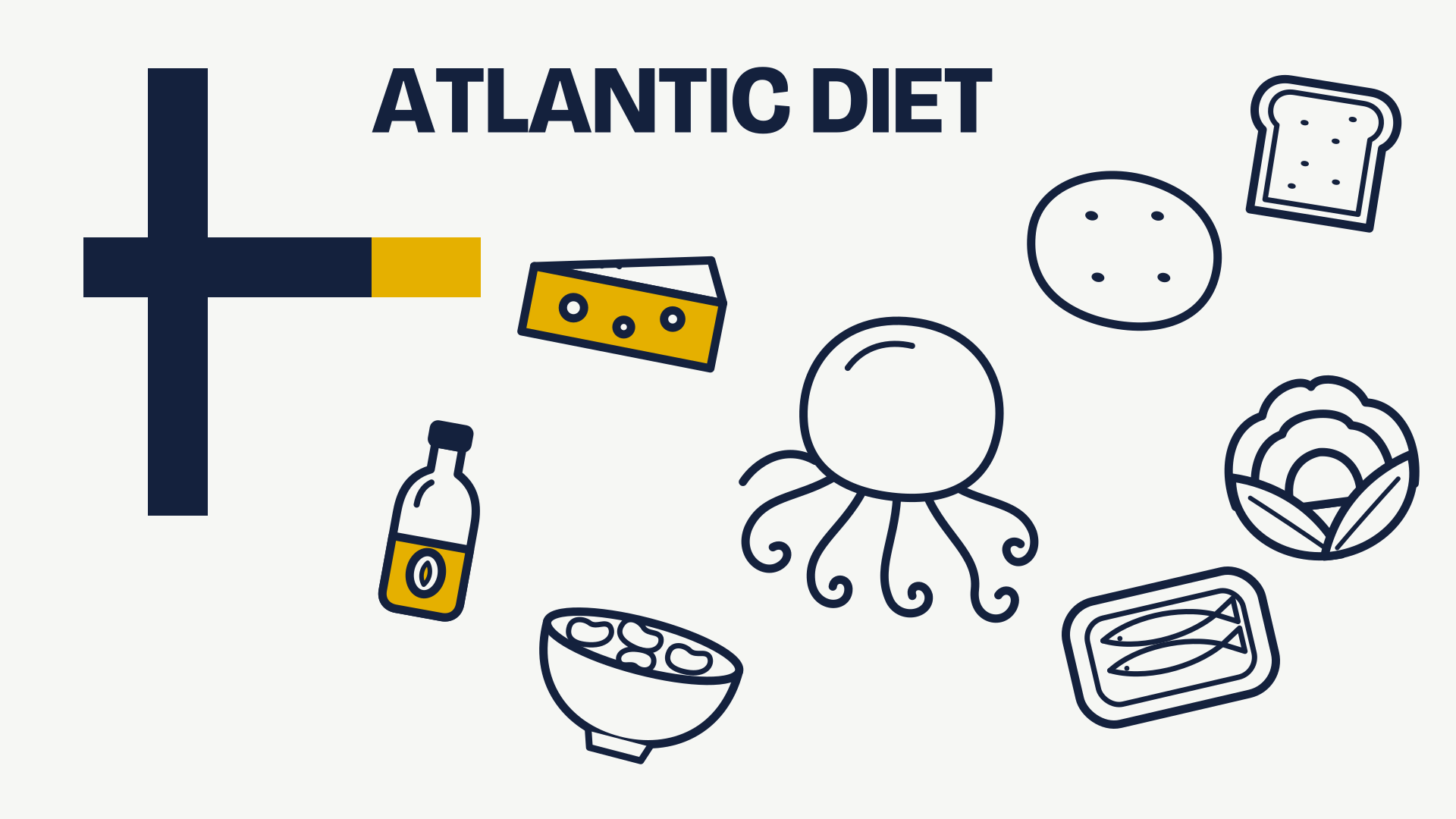
The Atlantic diet: the Mediterranean's rainy cousin, and it's catching up.
Galicia and northern Portugal eat differently from the sunny south: more fish, more soup, more potatoes, more cabbage. A Spanish trial put it to the test. The results are promising, the evidence is young.
The short version
- What it is
- Fish and seafood, vegetable soups, cabbage and greens, potatoes, beans, wholegrain bread, olive oil. Cooked at home, eaten together.
- Good for
- Lower odds of metabolic syndrome in one trial. Linked with longer life in large European cohorts.
- Bad at
- Strong proof. One trial, mostly observational data. And salt cod is, well, salty.
- Evidence
- Moderate. Promising, but young.
- Our take
- Core rule. This is where your plan gets its fish, its soup and its family dinners.
What the Atlantic diet actually is
It's the traditional way of eating in north-western Spain (Galicia) and northern Portugal. Same family as the Mediterranean diet, different weather. Researchers call it the Southern European Atlantic diet. Their description of it: fresh fish and cod, vegetables and vegetable soup, legumes, potatoes, wholegrain bread, dairy, some red meat and pork, and moderate wine.2
On the plate, that's a bowl of cabbage-and-potato soup, grilled sardines, octopus with potatoes and paprika, a hake stew, chestnuts in autumn, dark country bread. Olive oil is the fat. Food is cooked simply: boiled, stewed, grilled, baked. Not much fried, not much from a packet.
The part people skip: the eating itself. Meals are slow, at a table, with family. The researchers who tested it treated that as part of the diet, not decoration.
How it works in your body
No secret ingredient. It's a stack of good habits.
Fish several times a week brings protein and, from oily fish like sardines and mackerel, omega-3 fats. Soups and stews mean lots of vegetables in a form that fills you up for few calories. Beans, cabbage, kale and wholegrain bread bring fibre, which slows down how fast sugar reaches your blood. Olive oil replaces butter. And cooking at home means you decide how much salt, sugar and fat goes in, not a factory.
The meat is real, but it's a side character. Pork and beef show up in the traditional pattern, in modest amounts, next to a lot of plants and fish.
What you eat, what you don't
Eat
- Fish several times a week: sardines, mackerel, hake, cod
- Seafood: mussels, clams, octopus, squid
- Vegetable soups and stews, cabbage, kale, turnip greens
- Potatoes, boiled or baked; chestnuts
- Beans and chickpeas
- Wholegrain or rye bread
- Olive oil, garlic, onion, paprika
- Milk, yoghurt and cheese in moderate amounts
Forget it
- Sugar, soft drinks, sweets, packaged cakes
- Ready meals and fast food
- Deep-fried fish and chips as a habit
- Processed meat every day: chorizo is a seasoning, not a meal
- White bread at every meal
- Eating in front of a screen, alone, in four minutes
Alcohol on the Atlantic diet
OK, now and then
- A glass of dry white wine, like Albariño or Vinho Verde, with a fish meal
- A glass of dry red
- Wine topped up with sparkling water
Not part of the pattern
- Wine every day "because it's traditional"
- Port and other sweet fortified wines
- Herbal liqueurs and fire-water after dinner
- Beer by the litre with the seafood
50 Club: one glass of dry white with the Sunday fish lunch.
The researchers include moderate wine in their definition of the diet.2 We don't treat it as a health tip. The WHO says no level of drinking has been shown to be safe.7 All the details are in our alcohol guide.
What it's good for, with proof
Lower odds of metabolic syndrome
Metabolic syndrome is a cluster: a big waist, high blood pressure, high blood sugar, high triglycerides and low "good" cholesterol. It raises the risk of diabetes and heart disease. In the GALIAT trial in a rural Galician town, 250 families (574 people) were randomly split. Half got cooking classes, education and Atlantic-diet food for six months; the other half carried on as usual. The Atlantic group had about a third of the risk of developing metabolic syndrome.1
Honesty corner: that's a secondary analysis of one trial in one town, with relatively few new cases. Encouraging, not conclusive.
Linked with longer life across Europe
A study pooled four cohorts, almost 36,000 people in Spain, Czechia, Poland and the UK, followed for about 13 years. The more closely people ate this way, the lower their risk of dying from any cause, from heart disease and from cancer.2 The link was about as strong as for other well-known healthy diets. This is observational data: it shows a link, not proof of cause.
Fish is worth it
A big review in JAMA weighed the benefits of eating fish against the worry about contaminants like mercury. For adults, eating fish once or twice a week, especially oily fish, came out clearly on the plus side.3 Sardines, anchovies, herring, mackerel and cod are all on the US FDA's list of "best choices" for low mercury.4
The uncomfortable truth
"It's the omega-3s. Just take fish oil." No. A Cochrane review of 86 trials found that extra omega-3, mostly from capsules, made little or no difference to deaths from any cause.5 The VITAL trial, with nearly 26,000 people, also found no significant drop in major heart events from fish oil pills.6 The fish on your plate is not the same as a capsule in a jar. It comes with protein, vitamins, and it replaces a sausage.
"It's better than the Mediterranean diet." Headlines said so. The research doesn't. It's a close relative with less evidence, not a winner. Think of them as the same advice, with different weather and a different fish market.
The risks
- Salt. Salt cod, cured ham, chorizo, tinned fish and soups can add up fast. Soak salt cod well, check labels on tins and cartons, go easy with the salt shaker.
- Fish in pregnancy. If you're pregnant, the NHS says to avoid shark, swordfish and marlin, keep oily fish to two portions a week and tuna to four cans a week.8
- Fried and battered fish. Fried hake every night isn't what the trial tested. Stew, grill, bake.
- The wine. "Traditional" and "safe" are not the same thing.7
- Potatoes and bread. Fine as part of a meal full of vegetables and fish. Less fine as the main event, especially if you have type 2 diabetes.
Allergies: watch the staples
Fish and seafood are the heart of this diet, and they're among the most common serious allergies.
| Staple | Allergen (EU list of 14)9 | Swap |
|---|---|---|
| Sardines, cod, hake, mackerel | Fish | Beans, chickpeas, chicken, eggs; walnuts and flax for omega-3 |
| Prawns, crab, langoustines | Crustaceans | White fish (if no fish allergy), chicken |
| Mussels, clams, octopus, squid | Molluscs | White fish, chickpeas |
| Country bread, broa (corn and rye bread) | Cereals containing gluten | Potatoes, chestnuts, rice |
| Milk, cheese, yoghurt | Milk | Olive oil, unsweetened soy or oat alternatives |
| Soups and stews | Celery (often in the base) | Onion, leek, carrot, cabbage |
| Wine, tinned seafood in sauce | Sulphur dioxide and sulphites (check label) | Fish in olive oil or water; skip the wine |
Don't do the Atlantic diet if you…
- have a fish or shellfish allergy and plan to "just be careful": let the plan swap them out
- have been told to cut salt hard (heart failure, kidney disease) and can't avoid salt cod and cured meats
- are pregnant and don't follow the fish limits
- have had problems with alcohol: drop the wine completely, the rest works without it
Healthen me asks about all of these and gives you a different plan if any apply.
How we use the Atlantic diet in your plan
This is one of our core rules, next to the Mediterranean diet. It decides how often fish turns up: at least twice a week, oily fish included, with tinned sardines and mackerel counted as first-class food. If you're pescatarian, this is your home ground.
It also gives the plan its comfort food: big pots of vegetable soup and stew you cook once and eat for days. For readers in the DACH region, the Nordic diet covers the same idea with rye and rapeseed oil.
We keep our timing rules on top. You eat inside your eating window, the first meal is low-carb (sardines on greens, an omelette with vegetables), and potatoes and bread sit in the "sometimes" lane. And we nudge you to eat with people, at a table, without a phone. That's in the trial too.
This article is general information, not medical advice. If you have a medical condition or take medication, talk to your doctor before changing how you eat.
Sources
- Cambeses-Franco C et al. Traditional Atlantic diet and its effect on health and the environment: a secondary analysis of the GALIAT cluster randomized clinical trial. JAMA Network Open 2024;7(2):e2354473. doi.org/10.1001/jamanetworkopen.2023.54473
- Carballo-Casla A et al. The Southern European Atlantic diet and all-cause and cause-specific mortality: a European multicohort study. European Journal of Preventive Cardiology 2024;31(3):358–367. doi.org/10.1093/eurjpc/zwad370
- Mozaffarian D, Rimm EB. Fish intake, contaminants, and human health: evaluating the risks and the benefits. JAMA 2006;296(15):1885–1899. doi.org/10.1001/jama.296.15.1885
- US Food and Drug Administration. Advice about eating fish (revised October 2021). fda.gov/food/consumers/advice-about-eating-fish
- Abdelhamid AS et al. Omega-3 fatty acids for the primary and secondary prevention of cardiovascular disease. Cochrane Database of Systematic Reviews 2020;3:CD003177. doi.org/10.1002/14651858.CD003177.pub5
- Manson JE et al. Marine n-3 fatty acids and prevention of cardiovascular disease and cancer (VITAL). New England Journal of Medicine 2019;380(1):23–32. doi.org/10.1056/NEJMoa1811403
- WHO Regional Office for Europe. No level of alcohol consumption is safe for our health. News release, 4 January 2023. who.int/europe/news/item/04-01-2023-no-level-of-alcohol-consumption-is-safe-for-our-health
- NHS. Foods to avoid in pregnancy. nhs.uk/pregnancy/keeping-well/foods-to-avoid
- Regulation (EU) No 1169/2011 on food information to consumers, Annex II (the 14 allergens). eur-lex.europa.eu/eli/reg/2011/1169/oj