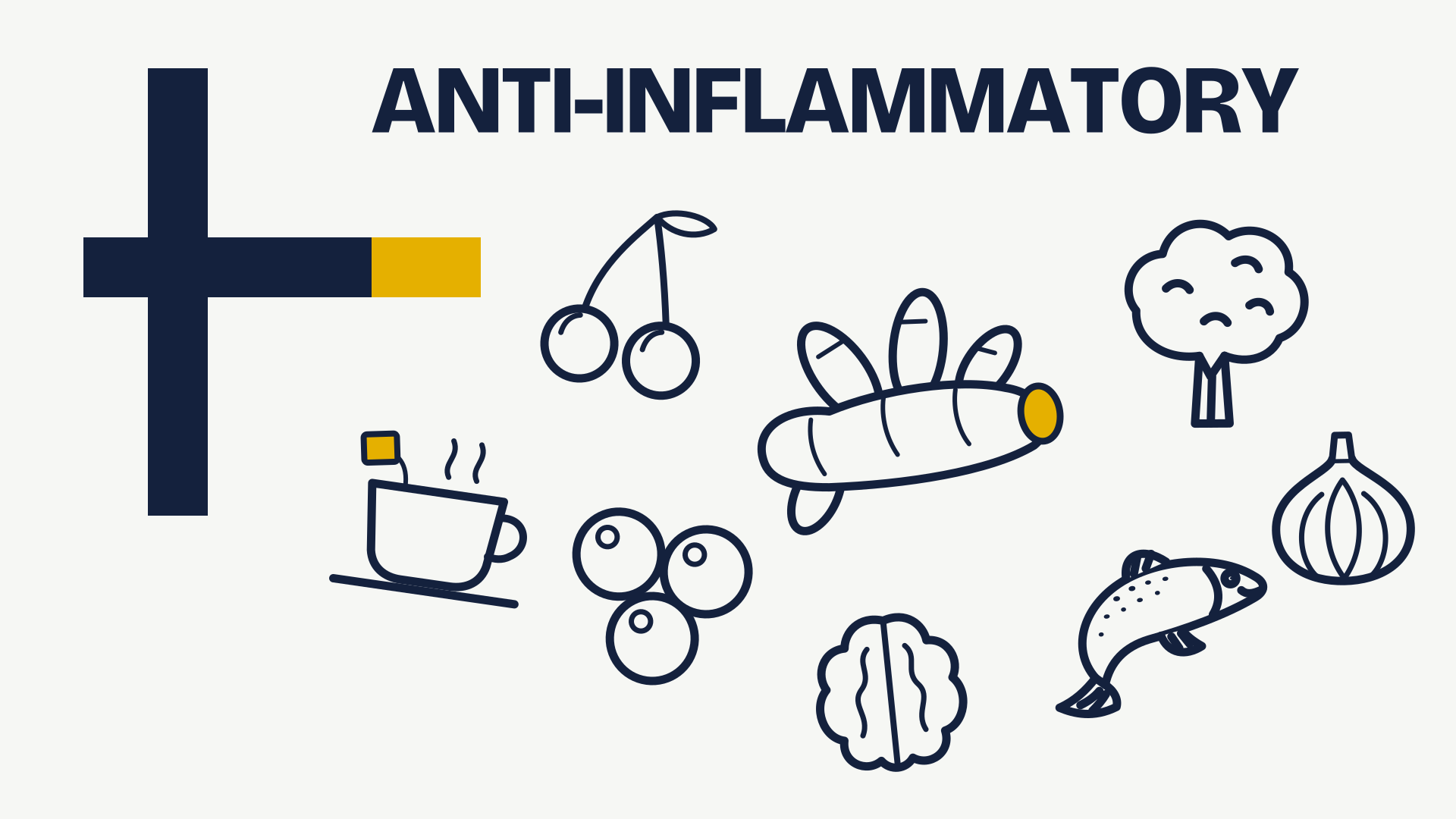
The anti-inflammatory diet: real science, buried under a mountain of turmeric lattes.
Inflammation is real, and long-term, low-level inflammation is linked with heart attacks, diabetes and some cancers. Food can nudge it. But not the way the wellness shop sells it.
The short version
- What it is
- Oily fish, olive oil, vegetables, berries, beans, nuts, whole grains, herbs and spices. Little processed food, sugar, processed meat or alcohol.
- Good for
- Lower inflammation markers in trials. Pro-inflammatory eating is linked with more heart attacks.
- Bad at
- Being a separate diet. It's basically Mediterranean with better PR. No single food is a cure.
- Evidence
- Moderate. Good for markers, mostly observational for disease.
- Our take
- One of our core goals. We just don't sell it with golden milk.
What the anti-inflammatory diet actually is
Inflammation is your immune system's fire brigade. Cut your finger, and the area gets red, warm and swollen while your body repairs it. That's good inflammation: short, local, done.
The problem is the other kind: a low, constant simmer through your whole body, for years. You don't feel it. Doctors see it in blood tests, for example as a raised C-reactive protein (CRP). It goes along with belly fat, smoking, inactivity, poor sleep and, yes, diet.
An anti-inflammatory diet is any way of eating built to turn that simmer down. There's no official version, no founder, no certificate. Researchers even built a score, the Dietary Inflammatory Index, that rates diets from anti- to pro-inflammatory based on what earlier studies found for each food and nutrient.1 Look at what scores well and you get something very close to the Mediterranean diet.
How it works in your body
Does inflammation itself cause heart attacks, or does it just tag along? A big drug trial answered part of that. In CANTOS, 10,061 heart attack survivors with high CRP got an antibody that only lowers inflammation, not cholesterol. At the dose that worked best, heart attacks, strokes and heart deaths dropped by about 15%.2 So inflammation isn't just a bystander.
Food can't do what that drug does, but it may push in the same direction. Researchers think several things work together: less belly fat, more fibre for your gut bacteria, more omega-3 fats from fish, and more plant compounds called polyphenols from olive oil, berries, vegetables, tea and spices. Which of these matters most isn't settled.
What is clear: the diets that lower inflammation markers in trials are built on whole foods, not on one hero ingredient.3 Which is why "anti-inflammatory" brownies are a joke.
What you eat, what you don't
Eat
- Oily fish: salmon, sardines, mackerel, herring
- Extra virgin olive oil
- Leafy greens, broccoli, peppers, tomatoes, onions
- Berries, cherries, citrus
- Beans, lentils, whole grains, oats
- Walnuts, almonds, flax and chia seeds
- Herbs and spices: garlic, ginger, turmeric, oregano
- Green tea, coffee, water
Forget it
- Sugar, soft drinks, sweets, pastries
- Processed meat: sausages, bacon, salami, ham
- White bread, white pasta, sugary cereal
- Fried food and fast food
- Ultra-processed snacks and ready meals
- Heavy drinking
Alcohol on the anti-inflammatory diet
OK, now and then
- A glass of dry red or white wine with a meal
- A spirit with soda water and lime
- A small beer
Works against you
- Several drinks in one evening
- Sweet cocktails, liqueurs, alcopops
- Mixers with sugar: cola, tonic, juice
- Red wine "for the antioxidants"
50 Club: one small glass of dry wine, with food, at the weekend.
Alcohol is a toxin your liver has to deal with first. The WHO says no safe level of drinking has been shown, and classes alcohol as a cause of at least seven types of cancer.7 If you want the polyphenols from grapes, eat grapes. All the details are in our alcohol guide.
What it's good for, with proof
Lower inflammation markers
A meta-analysis of 17 trials with about 2,300 people found that a Mediterranean-style diet lowered CRP, the most common blood marker of inflammation, compared with control diets. Blood vessels also worked better: they widened more easily, a sign of healthy vessel walls.3 This is the strongest direct evidence for the "anti-inflammatory" label.
Fewer heart attacks, in observational data
An umbrella review pulled together 15 meta-analyses covering more than four million people. Eating a more pro-inflammatory diet was linked with a higher risk of most of the 38 health outcomes studied. The most convincing link was with heart attacks. Highly suggestive links showed up for death from any cause and for several cancers, including bowel cancer.4 The catch: all of it is observational. It shows a link, not cause.
Joints: maybe, a little
Plenty of people with rheumatoid arthritis try diet changes. A Cochrane review found the trials too small and mixed to draw firm conclusions. One trial found a Cretan-style Mediterranean diet may reduce pain somewhat after 12 weeks.5 Worth a try alongside your treatment. Never instead of it.
The uncomfortable truth
"Turmeric fights inflammation." In a test tube, curcumin looks impressive. In people, the US National Institutes of Health says there isn't enough evidence to show turmeric or curcumin helps any condition definitively. High-strength curcumin supplements have been linked to liver injury in some people.6 Put turmeric in your curry because it tastes good. Don't drink it as medicine.
"Just take fish oil." In the VITAL trial, nearly 26,000 people took fish oil or a placebo for about five years. Major heart events: no significant difference.8 The fish works better on your plate than in a capsule, probably because it comes with protein and replaces something worse.
Anything labelled "anti-inflammatory" in the shop is marketing. EU law only allows approved health claims on food,9 and none of the approved ones says a food "reduces inflammation".
The risks
- Supplement creep. Turmeric capsules, fish oil, "inflammation blends". Expensive, mostly unproven, sometimes risky.6 Check with your doctor if you take blood thinners or other medication.
- Endless elimination. Some online versions ban nightshades, dairy, grains, legumes, eggs, all at once. That's not this diet. Cutting healthy foods for no reason makes eating miserable and can leave gaps.
- Food as a cure. If you have an inflammatory disease (rheumatoid arthritis, Crohn's, psoriasis, lupus), diet is a sidekick. Don't stop your treatment because a blog said kale would do it.
- Fish in pregnancy. Oily fish is central here. If you're pregnant, follow the NHS limits: no shark, swordfish or marlin, oily fish at most twice a week.10
Allergies: watch the staples
| Staple | Allergen (EU list of 14)11 | Swap |
|---|---|---|
| Salmon, sardines, mackerel | Fish | Walnuts, flax and chia for plant omega-3; beans, eggs |
| Walnuts, almonds | Tree nuts | Pumpkin, sunflower and flax seeds |
| Oats, whole wheat, barley | Cereals containing gluten | Buckwheat, quinoa, brown rice, certified gluten-free oats |
| Tofu, edamame | Soy | Lentils, chickpeas |
| Yoghurt, kefir | Milk | Unsweetened coconut or oat yoghurt |
| Tahini, sesame seeds | Sesame | Sunflower seed butter |
| Mustard dressings, curry blends | Mustard (check spice mixes) | Olive oil and lemon; single spices |
Don't do the anti-inflammatory diet if you…
- plan to use it instead of treatment for an inflammatory or autoimmune disease
- want to add high-dose turmeric or fish oil supplements while on blood thinners or other medication, without asking your doctor
- are drawn to the strictest elimination versions and have ever had an eating disorder
Healthen me asks about all of these and gives you a different plan if any apply.
How we use the anti-inflammatory diet in your plan
Less inflammation is one of Healthen's core goals, so this one is built into every plan. In practice, it shapes your food lists with the Mediterranean and Atlantic diets: oily fish twice a week or more, olive oil as the main fat, a rainbow of vegetables, berries, beans and nuts. Processed meat, sugar and soft drinks sit on the red list.
The MIND diet adds the extra berries and leafy greens. Our fasting and low-carb rules do their part too, by helping you lose belly fat.
What we don't do: sell you supplements, ban nightshades, or pretend a smoothie can fix your knees.
This article is general information, not medical advice. If you have a medical condition or take medication, talk to your doctor before changing how you eat.
Sources
- Shivappa N et al. Designing and developing a literature-derived, population-based dietary inflammatory index. Public Health Nutrition 2014;17(8):1689–1696. doi.org/10.1017/S1368980013002115
- Ridker PM et al. Antiinflammatory therapy with canakinumab for atherosclerotic disease (CANTOS). New England Journal of Medicine 2017;377(12):1119–1131. doi.org/10.1056/NEJMoa1707914
- Schwingshackl L, Hoffmann G. Mediterranean dietary pattern, inflammation and endothelial function: a systematic review and meta-analysis of intervention trials. Nutrition, Metabolism and Cardiovascular Diseases 2014;24(9):929–939. doi.org/10.1016/j.numecd.2014.03.003
- Marx W et al. The Dietary Inflammatory Index and human health: an umbrella review of meta-analyses of observational studies. Advances in Nutrition 2021;12(5):1681–1690. doi.org/10.1093/advances/nmab037
- Hagen KB et al. Dietary interventions for rheumatoid arthritis. Cochrane Database of Systematic Reviews 2009;1:CD006400. doi.org/10.1002/14651858.CD006400.pub2
- National Center for Complementary and Integrative Health (NIH). Turmeric: usefulness and safety. Updated April 2025. nccih.nih.gov/health/turmeric
- WHO Regional Office for Europe. No level of alcohol consumption is safe for our health. News release, 4 January 2023. who.int/europe/news/item/04-01-2023-no-level-of-alcohol-consumption-is-safe-for-our-health
- Manson JE et al. Marine n-3 fatty acids and prevention of cardiovascular disease and cancer (VITAL). New England Journal of Medicine 2019;380(1):23–32. doi.org/10.1056/NEJMoa1811403
- Regulation (EC) No 1924/2006 on nutrition and health claims made on foods. eur-lex.europa.eu/eli/reg/2006/1924/oj
- NHS. Foods to avoid in pregnancy. nhs.uk/pregnancy/keeping-well/foods-to-avoid
- Regulation (EU) No 1169/2011 on food information to consumers, Annex II (the 14 allergens). eur-lex.europa.eu/eli/reg/2011/1169/oj