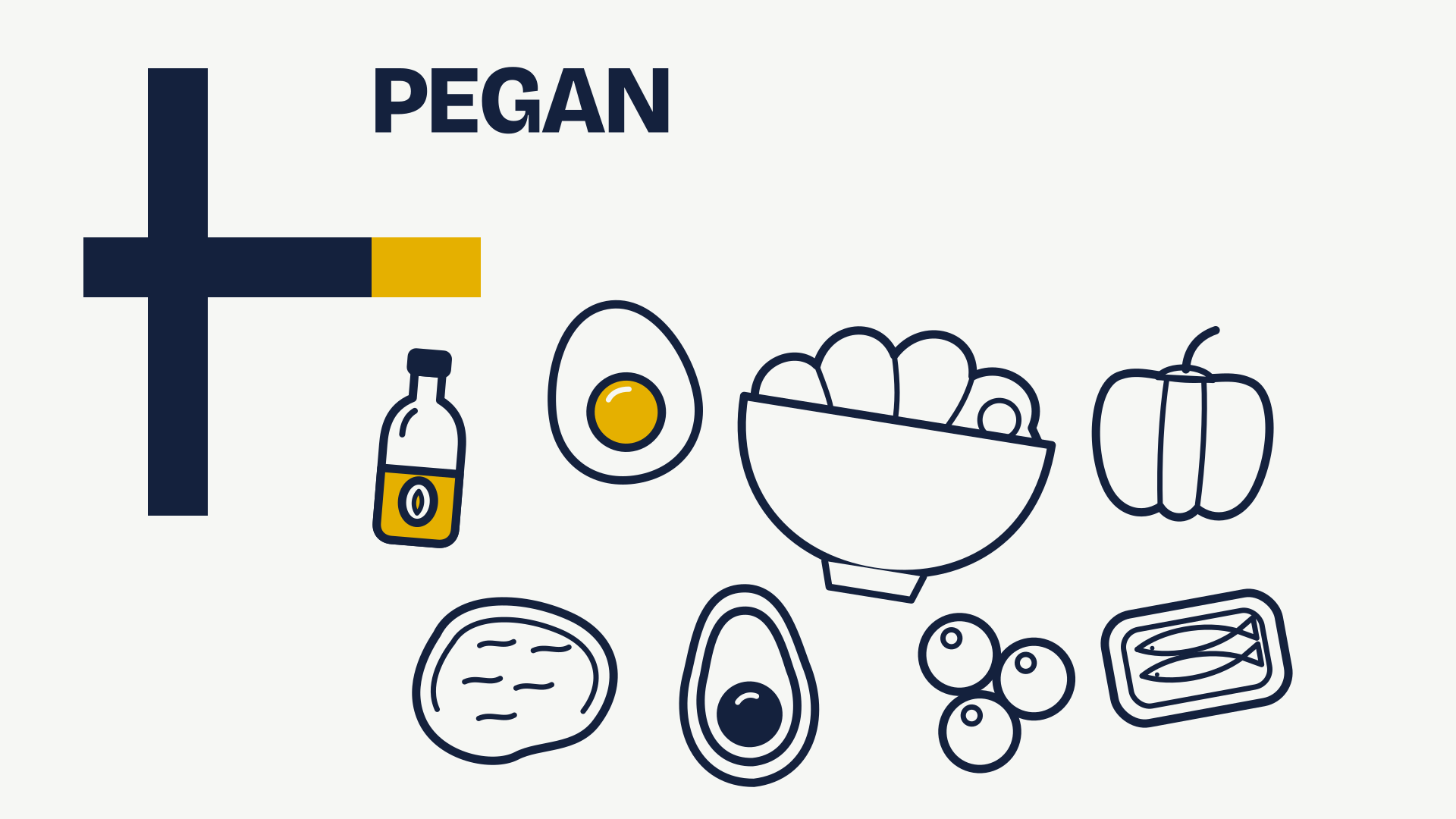
Pegan: three-quarters great advice, one-quarter bans nobody needs.
Take paleo, take vegan, keep the vegetables both of them love. The result is a plate most dietitians would happily sign off on, until it gets to the bit about beans, oats and yoghurt.
The short version
- What it is
- About 75% vegetables and fruit, meat as a side dish, no dairy, little or no gluten and grains, few legumes.
- Good for
- Getting you to eat a lot more vegetables and a lot less processed food.
- Bad at
- Evidence. There are no trials of the pegan diet itself.
- Evidence
- Weak. No trials of the diet; its parts have mixed support.
- Our take
- Love the plate. Ignore the bans on beans and whole grains.
What the pegan diet actually is
The pegan (paleo plus vegan) diet was launched in January 2015 by US doctor and author Mark Hyman, on his blog.1 The pitch: paleo and vegan people fight about meat, but agree that real food beats processed food. So build on what they agree on.
The rules, as described by dietitians who reviewed it: vegetables and fruit make up about three-quarters of what you eat. Meat is a "condiment", a side dish rather than the main act, and should be grass-fed or sustainably raised. Fish should be small, oily and low in mercury, like sardines. Nuts and seeds are in, peanuts are out. Dairy is out. Gluten and most grains are out or kept small. Legumes are limited. Sugar is an occasional treat. Industrial vegetable oils are avoided.1
A typical pegan day: eggs with spinach and mushrooms for breakfast; a huge salad with avocado, seeds and a few sardines for lunch; roasted vegetables with a palm-sized piece of chicken and a spoon of lentils for dinner; berries and a handful of almonds after. Nothing weird, nothing from a packet.
So it's not really half paleo and half vegan. It's paleo with a lot more vegetables, and with meat demoted from boss to sidekick.
How it works in your body
Nothing exotic. A plate that's three-quarters vegetables is high in fibre and water and low in calories, so you fill up on less. Cutting processed food, sugar and refined flour takes away most of what drives blood sugar spikes and grazing. A bit of meat, fish, eggs or nuts adds protein to keep you full.
The bans are where the theory comes in. Grains and legumes are limited because of worries about blood sugar and "anti-nutrients" like lectins and phytates; dairy goes because Hyman links it to weight gain and disease.1 Those worries are where the pegan diet leaves the evidence behind.
What you eat, what you don't
Eat
- Vegetables, lots of them, every colour
- Fruit, especially berries
- Nuts and seeds (not peanuts)
- Small oily fish: sardines, mackerel, wild salmon
- Eggs and a little grass-fed meat
- Olive oil, avocado, coconut
- Small amounts of lentils, black rice or quinoa
Forget it
- Milk, cheese, yoghurt
- Wheat, bread, pasta and gluten in general
- Sugar, sweets, soft drinks
- Refined vegetable oils
- Processed and packaged food
- Big portions of beans or grains
Pegan in Singapore and in Austria, Germany, Switzerland
Singapore: the wet market is a pegan's dream: kangkong, kailan, bitter gourd, long beans, tropical fruit and small fresh fish like ikan kuning. At hawker centres, the cai png stall with three vegetables and one fish is the closest you'll get. The traps: dairy hides in fewer dishes here, but sugar doesn't. Watch sweet sauces, kaya and bubble tea.
Austria, Germany, Switzerland: the farmers' market does most of the work: seasonal vegetables, berries in summer, apples and cabbage in winter. Herring, mackerel and trout are easy to find. The traps: Brezel, Semmel and the cheese counter. We'd keep the plain yoghurt and the Vollkornbrot anyway.
Alcohol on the pegan diet
OK, now and then
- A glass of dry red or white wine
- Clear spirits with soda water and lime
Not pegan
- Beer (grain, and lots of it)
- Cocktails, liqueurs, sweet wines
- Anything mixed with juice, cola or tonic
50 Club: one glass of dry wine with dinner.
Sugar is a sometimes food on pegan, and alcohol belongs in the same box. The World Health Organization says no safe level of drinking has been shown.6 All the details are in our alcohol guide.
What it's good for, with proof
There are no clinical trials of the pegan diet itself.1 So the honest way to judge it is by its parts.
The vegetables: strong support
A large analysis of 95 studies found that people who ate more fruit and vegetables had lower risks of heart disease, stroke and early death, with the benefit still growing up to about 800 grams a day.2 That's roughly ten portions. The pegan plate gets you there easily. These are observational studies, so they show a link, not proof, but the link is consistent.
Cutting processed food and sugar: sensible
Few nutrition experts argue with this part. It's the same direction as the Mediterranean diet, which has the best trial evidence of any eating pattern.
The uncomfortable truth
"Beans and grains are bad for your blood sugar and gut." The evidence points the other way. In 26 randomised trials, about one serving of beans, lentils or chickpeas a day lowered LDL cholesterol a little.3 And a big analysis of 45 studies linked more whole grains with lower risk of heart disease, cancer and early death.4
"Everyone is better off without gluten." Not if you don't have coeliac disease. In a cohort of more than 100,000 US health professionals, eating gluten wasn't linked with heart disease. The authors warned that avoiding it may mean losing whole grains, and said gluten-free diets shouldn't be promoted to people without coeliac disease.5
Pegan versus paleo
Pegan is often sold as the halfway point between paleo and vegan. Look at the plate and it's much closer to paleo: both cut dairy, gluten, most grains and processed food. The difference is the proportions. Paleo puts meat in the middle. Pegan pushes vegetables to three-quarters of the plate and demotes meat to a side dish, and it allows small amounts of legumes and grains like quinoa and black rice that strict paleo bans.1 So pegan is the better of the two. It's also the one whose bans we'd still throw out.
The risks
- Calcium and iodine. No dairy takes out a major source of both. You'll need to plan: leafy greens, tinned fish with bones, fortified plant milks, iodised salt or fish.
- Fibre gaps. Limiting beans and whole grains cuts some of your best fibre sources. Vegetables help, but you have to eat a lot of them.
- Cost. Grass-fed meat, wild fish, nuts and organic produce add up fast.
- Food anxiety. Long lists of "inflammatory" foods can make normal eating feel dangerous. That's a problem in itself.
Allergies: watch the staples
| Pegan staple | Allergen (EU list of 14)7 | Swap |
|---|---|---|
| Almonds, cashews, walnuts, nut milks | Tree nuts | Pumpkin and sunflower seeds, oat milk (if gluten is OK for you) |
| Sardines, mackerel, salmon | Fish | Eggs, poultry, flax and chia for omega-3 |
| Prawns, mussels | Crustaceans, molluscs | Fish, eggs |
| Eggs | Eggs | Fish, lentils, tofu (if soy is OK for you) |
| Tahini, sesame seeds | Sesame | Sunflower seed butter |
| Soups and broths | Celery | Fennel, leek, carrot |
Don't do pegan if you…
- are pregnant or breastfeeding, unless a dietitian checks your calcium, iodine and iron
- have kidney disease (protein, potassium and the rest need medical planning)
- have ever had an eating disorder: lists of banned foods aren't your friend
- are under 18
Healthen me asks about all of these and gives you a different plan if any apply.
How we use pegan in your plan
We don't, as a diet. Pegan is an information article for us, because there's no direct evidence for it and its bans throw out foods that do have evidence.
But its main rule is already in your plan: vegetables first, and lots of them. Your protein comes from fish, eggs, meat or plants. Beans, lentils, oats and plain yoghurt stay, because the studies support them. If you want to go fully plant-based, read our vegan article; if you want a strict 30-day reset, see Whole30.
This article is general information, not medical advice. If you have a medical condition or take medication, talk to your doctor before changing how you eat.
Sources
- Thalheimer JC. For your information: understanding the pegan diet. Today's Dietitian 2015;17(10):20. todaysdietitian.com/for-your-information-understanding-the-pegan-diet
- Aune D et al. Fruit and vegetable intake and the risk of cardiovascular disease, total cancer and all-cause mortality: a systematic review and dose-response meta-analysis of prospective studies. International Journal of Epidemiology 2017;46(3):1029–1056. doi.org/10.1093/ije/dyw319
- Ha V et al. Effect of dietary pulse intake on established therapeutic lipid targets for cardiovascular risk reduction: a systematic review and meta-analysis of randomized controlled trials. CMAJ 2014;186(8):E252–E262. pubmed.ncbi.nlm.nih.gov/24710915
- Aune D et al. Whole grain consumption and risk of cardiovascular disease, cancer, and all cause and cause specific mortality: systematic review and dose-response meta-analysis of prospective studies. BMJ 2016;353:i2716. doi.org/10.1136/bmj.i2716
- Lebwohl B et al. Long term gluten consumption in adults without celiac disease and risk of coronary heart disease: prospective cohort study. BMJ 2017;357:j1892. doi.org/10.1136/bmj.j1892
- WHO Regional Office for Europe. No level of alcohol consumption is safe for our health. News release, 4 January 2023. who.int/europe/news/item/04-01-2023-no-level-of-alcohol-consumption-is-safe-for-our-health
- Regulation (EU) No 1169/2011 on food information to consumers, Annex II (the 14 allergens). eur-lex.europa.eu/eli/reg/2011/1169/oj